

Freud’s Influence on Surrealism

Jen
the Texas Grumble

Surrealism was deeply connected to renowned psychiatrist Sigmund Freud‘s theories of the unconscious mind, dream imagery, and suppressed desires. Freud’s critical work was published in the early 1900’s, similarly to the birth surrealism. Additionally, Freud had very misogynistic ideals that were pushed into his work in psychiatry. Freud provided validation to the surrealist movement’s views on sexism and actually provided further justification for acts of violence, dominance, and control over women.

Freud developed the iceberg theory (McLeod) to metaphorically represent the mind’s three (3) levels:
- The conscious (visible tip of the iceberg);
- the preconscious (just below the surface); and
- the unconscious (vast submerged portion).
Freud viewed the unconscious mind as a vital part of the individual because he believed it to be irrational, emotional, and has no concept of reality. Freud believed that all of our primitive wishes and impulses are too painful to see. He concluded that individuals lock away the unconscious mind to prevent themselves from acknowledging their own unacceptable impulses (McLeod), which understandably enhances the lure of taboo. Individuals can repress their own unconscious mind through defense mechanisms like denial.
“[the unconscious mind] is irrational, emotional, and has no concept of reality” – Sigmund Freud
Freud believed that the unconscious mind contains our biologically based instincts for primitive urges for sex and aggression. Interestingly, the neurological pathway for sex and aggression are the same shared biological pathway. This provides one (1) explanation for why murder can be seen as a sexually explicit act for many serial killers and serial rapists. Sex and aggression are deeply linked in a cluster of neurons in the male amygdala and hypothalamus. pictured below. The amygdala-hypothalamus connection serves as a “switch” for social behaviors in males to help them regulate mating and aggression (Anderson).
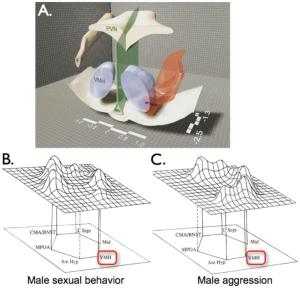
“Sex and aggression are deeply linked…The amygdala-hypothalamus connection serves as a “switch” for social behaviors in males to help them regulate mating and aggression” (Anderson).
Surrealism was influenced by psychiatrist Sigmund Freud‘s theories of the unconscious mind, dream imagery, and suppressed desires. Freud had very misogynistic ideals that were pushed through to his work in psychiatry. Therefore, any potential influence Freud had may also have misogyny twisted throughout. Surrealism certainly had a foundation of hatred against women. Freud provided validation to the surrealist movement’s views on sexism and actually provided further justification for acts of violence, dominance, and control over women. Surrealism and Freud promoted violence against women with sexual undertones. Freud and original surrealist artists were incredibly misaligned with regard to women in general, but both succeeded in highlighting a true societal problem of sexual violence existing in the depths of our most repressed desires, like with murder.
Freud and original surrealist artists…succeeded in highlighting a true societal problem of sexual violence existing in the depths of our most repressed desires, like with murder.
References
Anderson, David J. “OPTOGENETICS, SEX AND VIOLENCE IN THE BRAIN: IMPLICATIONS FOR PSYCHIATRY.” PMC, National Library of Medicine PMC PubMed Central, 15 December 2012, https://pmc.ncbi.nlm.nih.gov/articles/PMC3380604/. Accessed 5 March 2026.
McLeod, Saul. “Freud’s Theory of the Unconscious Mind: The Iceberg Analogy.” Simply Psychology, 25 January 2024, https://www.simplypsychology.org/unconscious-mind.html. Accessed 5 March 2026.
 the Texas Grumble
Leave a comment